 Amy Rabideau
"We integrate with suppliers" is a category, not a claim
I'm often asked how a distributor can tell one platform's supplier connections from another's. My answer is always the same: stop looking at the demo and start looking at the practical realities behind it.
Every platform in our industry says it integrates with suppliers. It's one of our favorite buzzwords, and most vendors using it are telling the truth, for some definition of integrate. That one word covers everything from a live connection into a supplier's system to a spreadsheet someone uploads on Friday afternoons. Both are real. Only one gives your team the operational backbone it needs.
Here's the good news: you don't have to take anyone's word for it. Our industry has a vendor-neutral, nonprofit standards body, PromoStandards, governed by volunteers from suppliers, distributors, service providers and technology companies. Because that shared framework exists, every question below has a real answer, not an opinion.
Seven questions. Each one has a definite answer. A vendor who can't give you one has answered anyway.
After each question, I've shared how we answer it at PromoLink. Transparency goes both ways, so hold us to the same bar.
1. Where does the data come from, and how often does it refresh?
Start here. This question explains most of what your team will later call "the system being wrong."
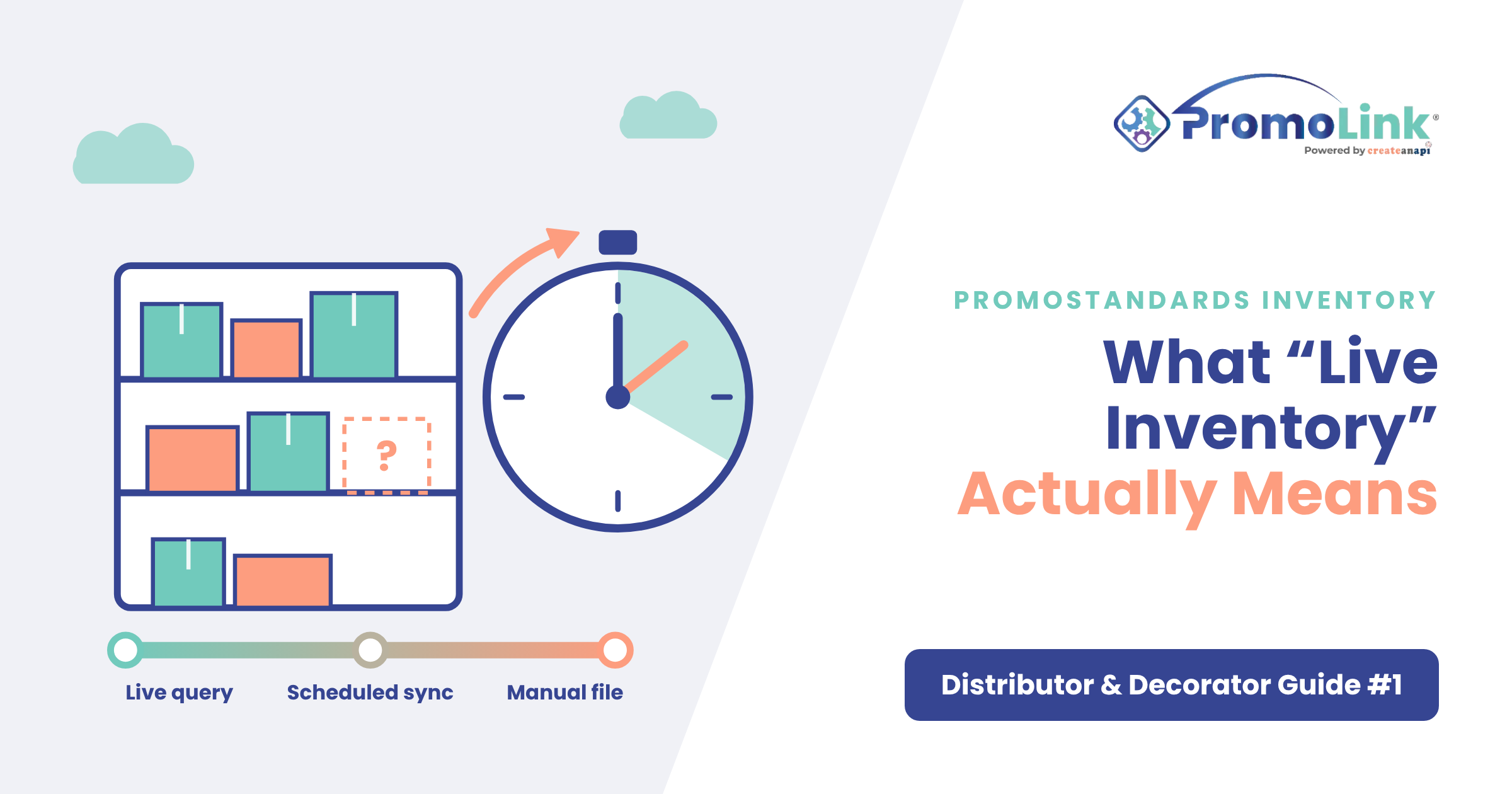
There are three ways a platform puts supplier data in front of you. It queries the supplier live, the moment you ask. It holds data that refreshes on a schedule, anywhere from every few hours to once a day. Or it serves a file someone uploads periodically.
All three are legitimate. They are not equal. Inventory refreshed six hours ago and inventory pulled one second ago look identical on your screen, right up until you sell stock that isn't there. You can't automate what you can't trust.
A good answer: a specific mechanism, a specific interval, and an honest admission that different suppliers run on different arrangements. That last part is how you know someone is describing reality.
A red flag: "real-time," full stop.
How we answer it: It depends on the data, and we'll tell you which is which. Supplier product data, media and list pricing refresh daily. Your own special pricing is pulled just in time, every time you need it. Inventory refreshes multiple times a day, on a schedule that varies by supplier.
2. Which data does it actually cover?
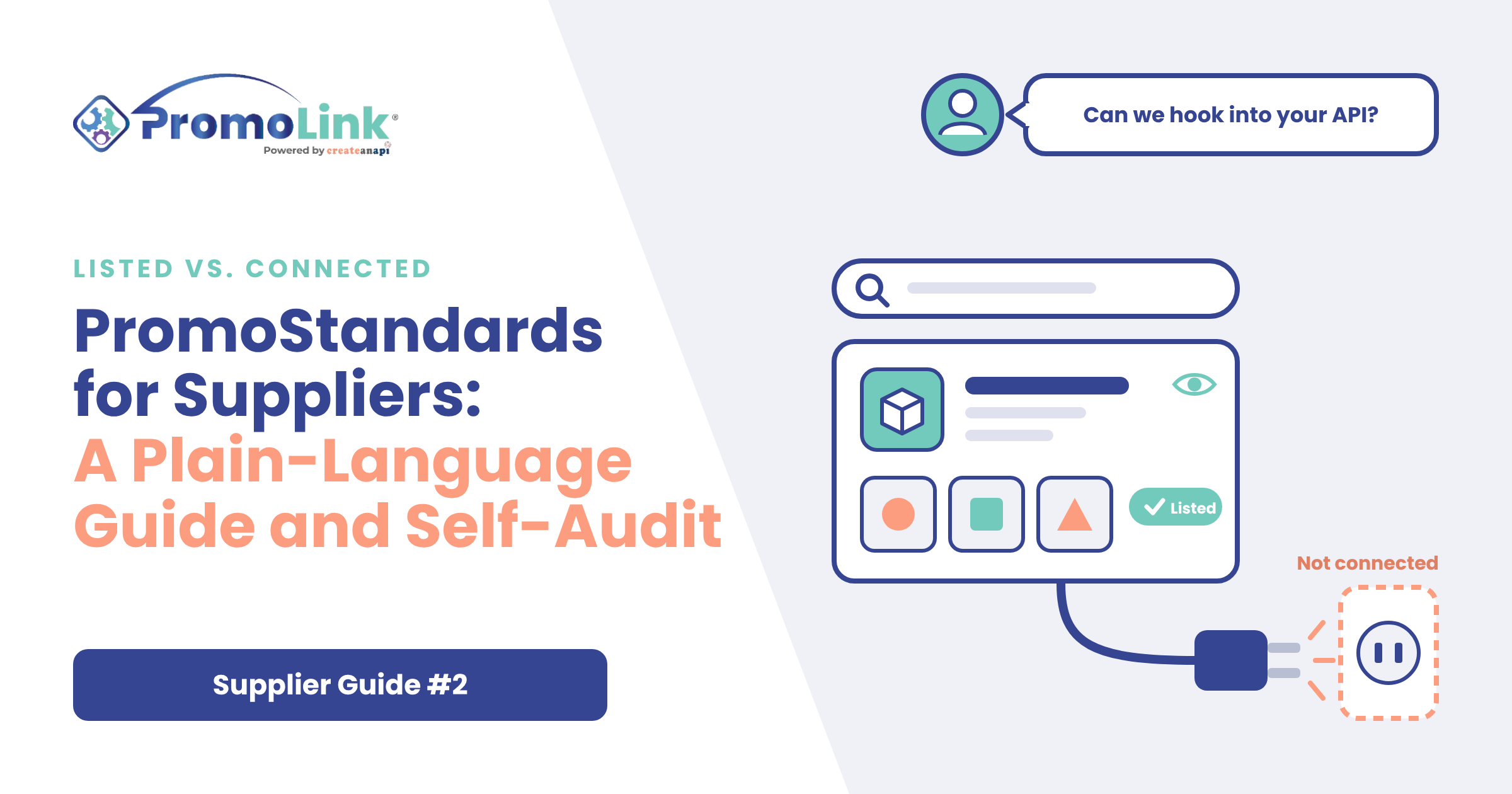
Integration isn't one connection. It's a set of them. The industry standard is built from separate services, each with one job: Inventory, Invoice, Media Content, Order Shipment Notification, Order Status, Product Compliance, Product Data, Product Pricing and Configuration, and Purchase Order..
A platform can be fully connected for product data and inventory and have nothing on the order side. That's common, and it's entirely compliant. It's also the difference between a platform that helps you quote and one that lets you transact.
A good answer: a named list of the services covered, with the order side addressed separately from the catalog side.
A red flag: a single "yes."
How we answer it: Every supplier record in PromoLink lists its connected PromoStandards services one by one. You control which of those services are turned on for each supplier, module by module, across Showcase, Sales Order and Storefront.
3. How many of my suppliers does it cover?
This is the question most often answered with the wrong number.
A vendor will tell you how many suppliers are in their network. That's their number, and it's a real achievement. But it isn't your number. Your number is how many of the suppliers you actually buy from are connected, for the services you actually need.
Those two numbers can be miles apart. A network of several hundred suppliers does very little for you if your top ten spend sits in the unconnected remainder.
A good answer: a vendor who maps your actual supplier list against their coverage before you sign, at the right level of detail. "We cover your top ten" is a conversation. "Here are your top ten, and here's which ones we have product data, pricing, inventory and order entry for" is a document you can make a decision with.
A red flag: a headline number offered as the whole answer, or reluctance to share the detail before you commit.
How we answer it: We show onboarded and not-yet-onboarded suppliers side by side, so the gap is visible rather than buried. You see which of your suppliers are connected, not just a network total.
4. Who issues the credentials, and who manages them?
Supplier connections aren't open by default. Access is granted supplier by supplier, with credentials the supplier issues, and somebody has to go request them.
Too many buyers learn this after they sign. That's when "connected to 400 suppliers" turns out to mean connected in principle, with someone still on the hook to get access to each one.
A good answer: who does that work, how long it typically takes, and what happens when a supplier is slow to respond.
A red flag: vagueness, or finding out the answer is you.
How we answer it: Credentials live on each supplier's record in PromoLink, in one place your team can see and manage. As part of our Enterprise Suite, we help you request credentials from the suppliers on your preferred list.
5. How will I know when it breaks?
Integrations rarely fail loudly. An endpoint stops responding or starts returning stale data, and nothing on your screen says so. You find out when your client does.
This is the most under-asked question in any integration evaluation. The answer tells you whether a vendor is invested in your operational reality, or just the demo. We talk constantly about integrations and automation, but none of it holds up without people who care about keeping those connections healthy every single day.
A good answer: monitoring exists, someone is watching it, you can see connection status yourself, and there's a defined path when something goes down.
A red flag: the question being treated as hypothetical.
How we answer it: Every supplier's connected services show their status in PromoLink. When one isn't working, you can see which one and what the issue is, before it lands on a client's order.
6. What is explicitly not included?
Every platform has edges. That's not the issue. The issue is whether a vendor will name them before you find them.
Ask what the system doesn't do. Ask what's on the roadmap versus what's shipping today. Ask what share of what you just saw is standard product and what share is custom work, quoted separately. A vendor who can answer in percentages is far easier to plan around than one who says anything is possible.
A good answer: a short, specific list of what's out of scope, shared without defensiveness.
A red flag: unlimited flexibility. Flexibility without scope is a cost you haven't been shown yet.
How we answer it: You'll know what's included before you sign. Whether you're using our standard integrations (PromoStandards, tax calculation, shipping estimates, e-commerce stores, shop floor transactions and accounting) or need a custom integration, you'll see a breakdown of cost and time up front.
7. What happens if I leave?
Ask where your data lives, what format you can export it in, what that export costs, and what happens to the supplier connections you spent months building.
This isn't a hostile question. It's a smart one. You're asking how reversible the decision is, which is worth understanding before you make it. The answer also tells you a lot about a vendor's confidence.
A good answer: a calm, concrete description of the exit.
A red flag: surprise that you asked.
How we answer it: Your data is your data. It's kept isolated in our infrastructure, and we're happy to return it to you. It comes back in PromoLink's database format rather than a spreadsheet, and depending on the volume and detail of your transactions, there may be a service fee.
Why these questions work in promo specifically
In a lot of software categories, buyers can't ask precise questions because there's nothing precise to ask about. Every vendor has its own architecture, and the comparison collapses into feature lists and demos.
Our industry is different. Because a shared, open standard exists, we have a common vocabulary for what "connected" actually means. PPAI makes the case that shared standards, rather than one-off custom integrations, help companies scale, cut maintenance and plug into a growing partner network. For a buyer, the takeaway is simpler: you can ask what specifically is connected, and there is a correct answer.
PromoStandards frames the before-and-after the same way. Before: email threads and phone tag for simple tasks. After: information straight from the source, untouched by people. That isn't just automation. It's interoperability, and whether a given platform actually delivers it is exactly what these seven questions are for.
And if you've been told this only pays off for the big players, it doesn't. PPAI notes that companies using PromoStandards range from under $1 million in annual revenue to over $1 billion.
Before your next vendor call
Print the seven. Ask them in order. Write down the answers, not your impressions.
Then do one more thing. It costs nothing and tells you the most: ask the same seven questions about the setup you have today. Most buyers find they can't answer several of them, and that's usually the real reason the evaluation started.
Better yet, compare notes with your peers. Ask what answers they got, and which ones held up after go-live. You don't have to navigate this alone, and a peer-validated answer beats trial and error every time.
Point these questions at us
When we talk about integration, we're really talking about three things: Trust, Transparency, and Experience. Clean, connected supplier data isn't just an internal operational win; it's what lets you offer your clients real-time answers and a seamless ordering experience. So we'd rather you put these questions to us than take our word for anything.
Start with question three. Send us your actual supplier list, and we'll show you what's connected and what isn't, supplier by supplier and service by service, before you commit to anything.

Written by
Amy Rabideau
Client & Community Engagement | Board Member & Mentor | ESG Advocate