---
title: "PromoStandards for Suppliers: A Plain-Language Guide and Self-Audit"
description: What PromoStandards actually is, what each of the nine services does, and five questions to find out whether your company is truly connected, or only listed.
image: https://www.promolink.io/hubfs/BLOG-2-banner-1200x630.png
---
[](https://www.promolink.io/)
- [Distributors](https://www.promolink.io/distributors)
[Overview](https://www.promolink.io/distributors) [Solutions](https://www.promolink.io/distributor-solutions) [Integrations](https://www.promolink.io/integrations)
- [Decorators](https://www.promolink.io/decorators)
[Overview](https://www.promolink.io/decorators) [Solutions](https://www.promolink.io/decorator-solutions) [Integrations](https://www.promolink.io/integrations)
- [Suppliers](https://www.promolink.io/suppliers)
[Overview](https://www.promolink.io/suppliers) [Solutions](https://www.promolink.io/suppliers-solutions) [Integrations](https://www.promolink.io/integrations)
- Solutions
Distributor
Supplier
Decorator
Enterprise
[Sales Team Suite](https://www.promolink.io/sales-team-suite-distributor) [Storefront Suite](https://www.promolink.io/storefront-suite-distributor) [AI PDF Order Entry](https://www.promolink.io/ai-pdf-order-entry)
A La Carte
[Supplier Index](https://www.promolink.io/supplier-index) [ShowCase](https://www.promolink.io/showcase) [Sales Order](https://www.promolink.io/sales-order) [Storefront](https://www.promolink.io/storefront) [Purchase Order](https://www.promolink.io/purchase-orders)
[All distributor solutions](https://www.promolink.io/distributor-solutions)
Supplier Solutions
[Supplier Product Manager](https://www.promolink.io/suppliers-product-manager) [AI PDF Order Entry](https://www.promolink.io/ai-pdf-order-entry) [Electronic Purchase Order](https://www.promolink.io/electronic-purchase-order) [Sage Integration](https://www.promolink.io/sage-integration)
[All supplier solutions](https://www.promolink.io/suppliers-solutions)
Enterprise
[AI PDF Order Entry](https://www.promolink.io/ai-pdf-order-entry) [Sales Team Suite](https://www.promolink.io/sales-team-suite-decorator) [Storefront Suite](https://www.promolink.io/storefront-suite-decorator)
A La Carte
[Supplier Index](https://www.promolink.io/supplier-index) [ShowCase](https://www.promolink.io/showcase) [Sales Order](https://www.promolink.io/sales-order) [Storefront](https://www.promolink.io/storefront) [Purchase Order](https://www.promolink.io/purchase-orders)
[All decorator solutions](https://www.promolink.io/decorator-solutions)
- Pricing
[Distributor](https://www.promolink.io/distributor-pricing) [Decorator](https://www.promolink.io/decorator-pricing) [Supplier](https://www.promolink.io/supplier-pricing)
- [Resources](https://www.promolink.io/blog)
[Blog](https://www.promolink.io/blog)
[Book a demo →](https://www.promolink.io/request-a-demo)
1. [Home](https://www.promolink.io/)
2. [Blog](https://www.promolink.io/blog)
3. PromoStandards for Suppliers: A Plain-Language Guide and Self-Audit
[← Back to blog](https://www.promolink.io/blog) [Read next: What "Live Inventory" Actually Means in PromoStandards](https://www.promolink.io/blog/what-live-inventory-actually-means-in-promostandards)
[Guide](https://www.promolink.io/blog?topic=guide) [B2B](https://www.promolink.io/blog?topic=b2b)
# PromoStandards for Suppliers: A Plain-Language Guide and Self-Audit
What PromoStandards actually is, what each of the nine services does, and five questions to find out whether your company is truly connected, or only listed.
 Amy Rabideau October 16, 2026 14 min read

On this page
## **"Do you have a PromoStandards API we can hook into?"**
If you supply promotional or decorated products, you've almost certainly received that email. And if you're like most of the suppliers I talk with, your honest first reaction was something like: I think so? Let me find out who would know.
That moment matters more than it looks. Distributors aren't asking about technology for its own sake. They're asking whether they can do business with you without the email threads, phone tag and retyping that slow everyone down.
This guide is for answering that question with confidence: what PromoStandards is, what each piece does, and how to check your company's real status instead of guessing. It's written for the commercial side of a supplier business, not for developers.
## **What PromoStandards actually is**
PromoStandards is a set of shared technical standards that let suppliers and distributors exchange information automatically, instead of by email, phone and spreadsheet. It's run by a volunteer-driven, not-for-profit organization whose goal is smoother supply chains and transactions across our industry.
Three points clear up most of the confusion.
**It isn't a platform, and it isn't a company you buy from.** Nobody sells you "PromoStandards." It's a specification. You implement it, or someone working on your behalf does. PromoStandards says so itself: it guides the standards, a shared roadmap developers code against, but it doesn't write or sell software.
**It isn't one thing.** It's nine separate services, and a supplier can support any combination of them. This is the most common misunderstanding out there: "we're on PromoStandards" is not a yes-or-no fact about your company.
**It doesn't replace your ASI, SAGE or DistributorCentral presence.** Those are where distributors discover your products. PromoStandards is how their systems talk to yours. Plenty of suppliers assume one cancels out the other. It doesn't. They work together.
## **The nine services, in plain language**
Each service answers one question a distributor's system needs answered. Here's the full set, and what each one does for your business.
| **Service** | **What it answers** | **Why a distributor wants it** |
| --- | --- | --- |
| Product Data | What do you sell? | Your catalog (descriptions, colors, sizes, categories) flows into their system without anyone retyping it |
| Media Content | What does it look like? | Product images and documents arrive automatically and stay current |
| Product Pricing and Configuration (PPC) | What does it cost, in what configuration? | Accurate pricing, including decoration options, without a phone call |
| Inventory | Do you have it, right now? | Live stock levels, so they stop promising what you can't ship |
| Product Compliance | Does it meet the requirements? | Compliance and certification data for buyers who need it |
| Purchase Order | Here's the order. | Orders land in your system electronically instead of as an email someone re-keys |
| Order Status | Where is it? | Their customer service gets answers without emailing yours |
| Order Shipment Notification (OSN) | It shipped. Here's the tracking. | Tracking flows back automatically |
| Invoice | Here's the bill. | Invoices arrive in a format their accounting can process |
Notice the shape of that list. The first five describe your products. The last four handle a transaction. Most suppliers who've done anything at all have done some of the first group and none of the second, and that's exactly the state that produces a distributor asking whether they can "hook in" and getting a vague answer.
**Current versions (as of October 2026).** Services are versioned, and more than one version can be live at once: Product Data 1.0.0 and 2.0.0 · Media Content 1.1.0 · PPC 1.0.0 · Inventory 1.2.1 and 2.0.0 · Product Compliance 1.0.0 · Purchase Order 1.0.0 · Order Status 1.0.0 and 2.0.0 · Order Shipment Notification 1.0.0 and 2.0.0 · Invoice 1.0.0.
These will change. Treat this list as a snapshot, not a permanent fact. The goal here isn't to be the thing you check. It's to show you how to check.
## **"Listed" and "connected" are not the same thing**
Here's the distinction that matters commercially.
**Listed** means your company appears somewhere: a directory, a platform, a member list. A distributor can see your name.
**Connected** means a distributor's system can make a live call to yours and get a real answer, right now.
A supplier can be listed and not connected. It happens more often than you'd expect, and for very human reasons. The endpoints were built years ago by someone who has since moved on. A platform migration quietly broke them. The product data service works, but nobody ever built the order side. Credentials went to three distributors in 2021, and nobody has checked since.
The symptom is specific: distributors stop asking, and you never find out why. There's no error message for a supplier who looks integrated and isn't. You can't fix what you can't see.
## **The self-audit: five questions**
Run these in order. Each one has a definite answer, and you don't need a developer for the first four.
**1. Which of the nine services do we actually have live?** Not "are we on PromoStandards." Name them. If nobody in the building can answer this in a meeting, that's your finding.
**2. When was each one last verified working?** Not built. Verified. An endpoint that returned good data in 2023 and has been quietly failing since is worse than no endpoint at all, because you're still listed. While you're at it, ask how often each service's data actually updates. The PromoStandards Best Practices committee recommends committing to a publishing cadence per service, in one of four tiers: hourly or faster, every one to eight hours, daily, or weekly.
**3. Can a distributor place an order electronically today?** This is the question with revenue attached. Product Data and Inventory make you findable and accurate. Purchase Order, Order Status, OSN and Invoice are what let a distributor run business through you without anyone typing. If you have the first group and not the second, you're discoverable, but not transactable.
**4. Who owns this internally, and do they still work here?** The most common root cause of a broken integration isn't technical. It's organizational. If the answer is a name followed by a pause, you've found your real risk. Technology never moves forward without people who care about keeping it healthy. The committee's credential guidance points the same way: name the people who issue credentials, keep your technical contact on PromoStandards current so requests don't go missing, and make sure your sales team and CSRs know where to send a distributor who asks.
**5. What do distributors see when they look us up?** Public directories show, supplier by supplier, which services are implemented and when each was last validated. Look your company up the way a distributor would, before the next one does it for you. PromoStandards' own site has a public endpoint listing and a web service validator, and its Best Practices committee publishes an Integration Self Assessment Questionnaire for suppliers. If a service provider hosts your endpoints, the committee suggests filling it out with their help.
If you can't answer questions 1 and 2 from memory, the good news is the data is retrievable. PromoStandards publishes a service API for querying company registrations and service versions, available over SOAP and a read-only REST/JSON interface.
## **Where to start, if you're starting**
Some of this is documented, and some is our judgment, so take the second part as reasoning you can argue with. The documented part first: the PromoStandards Best Practices committee, drawing on its members' real implementations, describes two common starting paths. The transactional path runs Inventory, then Order Status, then Order Shipment Notification. The non-transactional path runs Media, then Product. Both eventually need Pricing and Configuration before Purchase Order, and the committee notes PPC is widely regarded as the hardest service to build. Our take on top of that:
**Start with Inventory if you have any inventory worth reporting.** It has the most immediate commercial effect: distributors stop selling what you don't have, and your customer service stops fielding "is this in stock?" calls. It's usually the first thing distributors ask about, too.
**Do Product Data and Media Content as one project.** They describe the same catalog, and splitting them means touching the same data twice.
**Treat the order-side services as a set.** Purchase Order without Order Status leaves the distributor blind after they've ordered, which creates exactly the phone calls the integration was meant to eliminate. Purchase Order, Order Status, OSN and Invoice together are what "we can transact electronically" really means.
**Don't start with the order side just to impress one large buyer,** unless that buyer's volume justifies it on its own. It's rarely the cheapest path to the broadest benefit.
**Soft-launch before you announce.** The committee strongly recommends releasing a new service first to a few hand-picked distributors who'll give honest feedback, before publishing it on promostandards.org. Then enable accounts in waves: turn on a few, measure performance, turn on a few more.
## **What good looks like after launch**
Going live is the start of the relationship, not the end of the project. The Best Practices committee highlights a few habits that separate a trusted integration from a fragile one.
**Set expectations up front.** Commit to a publishing cadence for each service, and give distributors a place to report problems with a response time you'll stand behind. The committee suggests a monitored shared inbox rather than one person's email.
**Keep a log of who's calling and what they asked for.** Audit logs let you troubleshoot a reported issue, show how many distributors use each service, and plan for outages. They're also how you tell your success story internally.
**Protect yourself from bad calls.** Sooner or later a distributor's code will loop and hammer your endpoints. Rate limiting, documented in your integration guide, and the ability to disable a single account keep one problem from becoming everyone's problem.
**Hand out credentials carefully.** Send them through secure channels, label usernames and passwords clearly, include every endpoint URL they apply to, and note any extra requirements such as IP whitelisting or call limits.
## **Versions move, and that's the part people underestimate**
The standards get revised. Order Status is the clearest current example: OS 1.0.0 was released in 2015, and OS 2.0.0 was co-authored in 2023. The newer version changed the queryType field from an integer to a string, recommended UTC for timestamps, and added two new fields, one for communicating order issues and one for returning the items on the order.
Two things follow, whether you build in-house or not.
First, an implementation is not a finished project. Something has to keep up with the standards as they change, and that something is either a person on your payroll or a service you pay for. In our experience, suppliers who wrote their own endpoints years ago are the most likely to be quietly out of date. Not from neglect, but because maintaining a specification you don't control is a recurring cost nobody budgeted for.
Second, the official OS 2.0.0 announcement doesn't state a migration deadline, and we're not going to invent one. Nobody will force you off an older version on a known date. That sounds reassuring, and it isn't entirely. It means the pressure arrives from your customers instead, one request at a time, usually with less notice.
## **Build, outsource, or use a platform**
Three real options, honestly described.
**Build in-house.** You control it completely. You also own every future version change, and the knowledge usually lives in one person's head. This works well for suppliers with real development capacity and a reason to keep it close.
**Use a service provider.** Someone else builds and hosts your endpoints and keeps them current as the standards move. You give up some control and pay a recurring cost. PromoStandards itself recognizes both paths: members either work with a service provider or do the work in-house.
**Rely on a platform you already sell through.** Some distributor-facing platforms will surface your data without you implementing anything yourself. It's the lowest-effort option. The trade-off is that your integration status then depends on someone else's roadmap and someone else's business decisions.
There's no universally correct answer. There is a wrong one: assuming the question has been handled because it was discussed once.
**Full transparency:** being a service provider is what we do at PromoLink, so weigh our enthusiasm accordingly. Here's what that looks like in practice. Our Supplier Product Manager hosts your product data, media, pricing and inventory endpoints and keeps them current as PromoStandards adds and revises services. Our ePO package adds purchase order, order status and shipment notification endpoints, and suppliers without them still receive orders by email in the meantime. Distributor queries hit our endpoints, not your back-end systems. And every service lets you send a live test request and see a log of what distributors actually asked for, so question 2 above has an answer without calling a developer.
## **Frequently asked questions**
**Is PromoStandards free?** The standards themselves are published by a not-for-profit organization, and membership is open by application. Implementation (building, hosting and maintaining endpoints) is a separate cost, and it depends entirely on how you do it. Anyone quoting you an "industry-standard" price for this is guessing.
**Do I need all nine services?** No. Suppliers implement subsets, and the right subset depends on what you sell and how distributors buy it. A supplier with under 200 SKUs and no live inventory has a very different answer than one shipping from three warehouses.
**Does this replace my ASI or SAGE listing?** No. Those are how distributors discover your products. PromoStandards is how their systems transact with yours. They coexist.
**We're already listed somewhere. Doesn't that mean we're integrated?** Not necessarily. That's the whole point of this guide. Run the five questions above.
**How do I know what distributors see about us?** Public supplier directories show implemented services and last-validated dates for each supplier. Look yourself up.
**Where are the actual specifications?** On promostandards.org, behind a member login. That's worth knowing, because it's part of why this topic is murkier than it should be. The detailed documentation isn't something a curious commercial manager can simply browse. The PromoStandards Best Practices site, on the other hand, is public, with separate sections for suppliers and distributors. It's worth bookmarking.
**Where can I get help without hiring anyone?** Start with the community. PromoStandards runs free Virtual Office Hours on the third Tuesday of every month, where you can bring your questions. Its site also has a member directory, a service provider directory and a getting-started video for new members, and the annual Tech Summit brings suppliers, distributors and service providers into the same room.
## **We rise together**
When we talk about PromoStandards, we're really talking about three things: Trust, Transparency, and Experience. Being connected isn't just an IT win. It's what lets your distributors quote with confidence, order without friction, and give their clients real answers.
So run the five questions this week. Share them with your team. Compare notes with peers who've been through it, because a peer-validated answer beats trial and error every time. And if you'd like a second set of eyes on what you find, we're always happy to talk it through.
[**Let's talk**](https://www.promolink.io/request-a-demo)
Share this article
[LinkedIn](https://www.linkedin.com/sharing/share-offsite/?url=https%3A%2F%2Fwww.promolink.io%2Fblog%2Fpromostandards-for-suppliers-a-plain-language-guide-and-self-audit) [X](https://twitter.com/intent/tweet?url=https%3A%2F%2Fwww.promolink.io%2Fblog%2Fpromostandards-for-suppliers-a-plain-language-guide-and-self-audit&text=PromoStandards+for+Suppliers%3A+A+Plain-Language+Guide+and+Self-Audit) [Facebook](https://www.facebook.com/sharer/sharer.php?u=https%3A%2F%2Fwww.promolink.io%2Fblog%2Fpromostandards-for-suppliers-a-plain-language-guide-and-self-audit)
Copy link

Written by
Amy Rabideau
Client & Community Engagement | Board Member & Mentor | ESG Advocate
## You might also like
[View all posts →](https://www.promolink.io/blog)
### [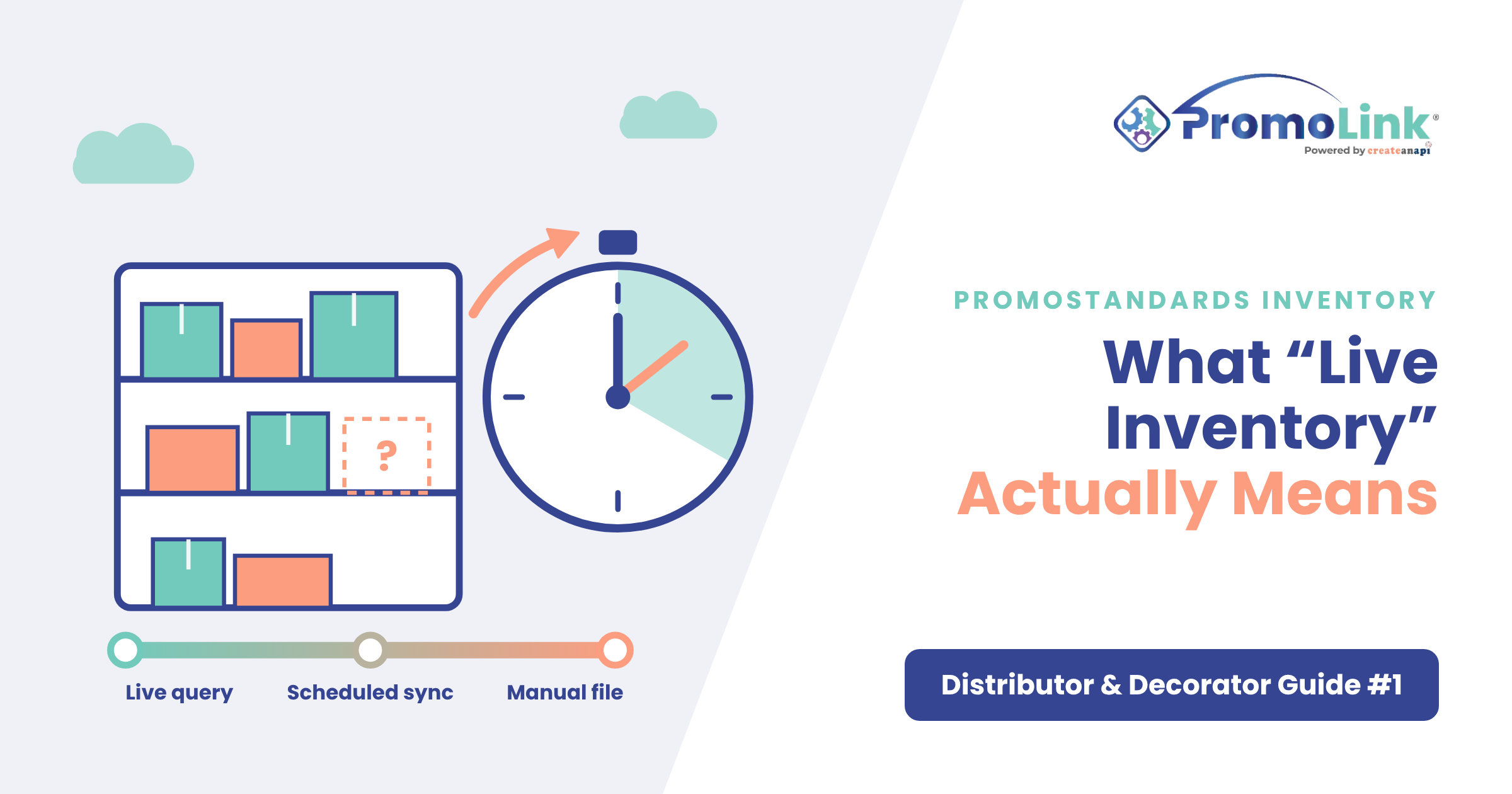 GuideB2B +1 What "Live Inventory" Actually Means in PromoStandards The number wasn't a lie. It was just older than you thought. Every distributor has had this conversation. You quoted 500 units because the screen said 800 were available.… Oct 14, 2026 10 min read](https://www.promolink.io/blog/what-live-inventory-actually-means-in-promostandards)
### [ IdeasGuide The cost of fragmented sourcing Sourcing is one of the most important parts of the job, yet it often takes more effort than expected. Most sourcing starts with an idea. A keyword. A product type. A use … Feb 3, 2026 3 min read](https://www.promolink.io/blog/the-cost-of-fragmented-sourcing)
### [ MarketingIdeas +1 Promo Supply Chain Integration White Paper The promotional products industry often faces challenges from fragmented systems, miscommunications, and manual processes. These challenges can lead to delays, errors, an… Sep 11, 2024 1 min read](https://www.promolink.io/blog/promo-supply-chain-integration-white-paper)
## Follow Us on Social Media
Contents
On this page
End-to-end platform that manages your entire promo workflow.
One ecosystem. Every connection.
Modular when you need it.
[Book a demo](https://www.promolink.io/request-a-demo)[Read our blog](https://www.promolink.io/blog)
##### Distributors
[Overview](https://www.promolink.io/distributors) [Solutions](https://www.promolink.io/distributor-solutions) [Integrations](https://www.promolink.io/integrations)
[Sales Team Suite](https://www.promolink.io/sales-team-suite-distributor) [Storefront Suite](https://www.promolink.io/storefront-suite-distributor) [AI PDF Order Entry](https://www.promolink.io/ai-pdf-order-entry)
[Pricing](https://www.promolink.io/distributor-pricing)
##### Decorators
[Overview](https://www.promolink.io/decorators) [Solutions](https://www.promolink.io/decorator-solutions) [Integrations](https://www.promolink.io/integrations)
[Sales Team Suite](https://www.promolink.io/sales-team-suite-decorator) [Storefront Suite](https://www.promolink.io/storefront-suite-decorator) [AI PDF Order Entry](https://www.promolink.io/ai-pdf-order-entry)
[Pricing](https://www.promolink.io/decorator-pricing)
##### Suppliers
[Overview](https://www.promolink.io/suppliers) [Integrations](https://www.promolink.io/integrations)
[Supplier Product Manager](https://www.promolink.io/suppliers-product-manager) [EPO Solution](https://www.promolink.io/electronic-purchase-order) [SAGE Integration](https://www.promolink.io/sage-integration) [AI PDF Order Entry](https://www.promolink.io/ai-pdf-order-entry)
[Pricing](https://www.promolink.io/supplier-pricing)
##### Modules
For distributors & decorators
[ShowCase](https://www.promolink.io/showcase) [Sales Order](https://www.promolink.io/sales-order) [Storefront](https://www.promolink.io/storefront) [Purchase Order](https://www.promolink.io/purchase-orders)
[Supplier Index](https://www.promolink.io/supplier-index)
San Tan Valley, AZinfo@promolink.io888 977 4540
© 2026 PromoLink. All Rights Reserved.
```json
{
"@context" : "https://schema.org",
"@type" : "BlogPosting",
"author" : {
"@type" : "Person",
"name" : "Amy Rabideau",
"url" : "https://www.promolink.io/blog/author/amy-rabideau"
},
"dateModified" : "2026-10-16T16:29:23.988Z",
"datePublished" : "2026-10-16T16:29:23.000Z",
"headline" : "PromoStandards for Suppliers: A Plain-Language Guide and Self-Audit",
"image" : [ "https://www.promolink.io/hubfs/BLOG-2-banner-1200x630.png" ],
"mainEntityOfPage" : {
"@id" : "https://www.promolink.io/blog/promostandards-for-suppliers-a-plain-language-guide-and-self-audit",
"@type" : "WebPage"
},
"publisher" : {
"@type" : "Organization",
"logo" : {
"@type" : "ImageObject",
"url" : "https://www.promolink.io/hubfs/PromoLink_R_2024_RGB-1-1.png"
},
"name" : "CreateAnAPI"
}
}
```